Building a World-Class Life Sciences District in Sutton and South London
Life sciences innovation does not happen in isolation. It happens in places shaped by people, partnerships and long-term commitment. With planning consent now secured for the London Cancer Hub, Sutton and South London stand at a defining moment: the transition from vision to delivery of one of the most significant life sciences districts in the UK.
This milestone matters not only for Sutton, but for South London as a whole. It reflects a wider ambition across the sub-region to drive inclusive growth, build on local strengths and ensure that opportunity is shared. The London Cancer Hub is a clear example of how that ambition can be realised through collaboration, patience and long-term thinking.
Why local places matter to global innovation
Across South London, there is growing recognition that the capital’s future competitiveness depends on strong, distinctive places, each contributing something different to London’s overall economy. Recent commentary in the life sciences sector suggests that the next breakthroughs will be built from the ground up: rooted in local ecosystems, shaped by real communities, and sustained by relationships as much as infrastructure.
That thinking aligns closely with the South London Partnership’s focus on place-based growth, skills development and sector specialism. The London Cancer Hub exemplifies this approach. It is not a speculative cluster created in response to a market trend, but a district emerging from an extraordinary existing foundation in Sutton — home to The Royal Marsden NHS Foundation Trust and the Institute of Cancer Research, institutions that already place South London firmly on the global map for cancer research and treatment.
Planning consent now provides the framework to build on that foundation in a coordinated, regional context, strengthening South London’s contribution to London’s life sciences ecosystem as a whole.
Recognising the effort behind the milestone
Securing planning consent for a development of this scale and sensitivity is never straightforward. It requires ambition, but also deep engagement with local communities and a willingness to listen, respond and adapt. The London Cancer Hub has been shaped through years of technical work, consultation and partnership.
This outcome reflects the collective effort of many — including local residents, clinicians, researchers, public-sector partners and investors — and mirrors the collaborative model promoted by the South London Partnership: boroughs, institutions and organisations working together to deliver long-term benefit rather than short-term wins.
Planning consent is therefore not just a regulatory milestone. It is a signal of confidence in the vision for Sutton, and in South London’s ability to deliver complex, globally significant projects in ways that are grounded in place and responsive to local need.
The London Cancer Hub as a district
With consent secured, it is important to be clear about what the London Cancer Hub represents.
This is not a single development, but a district that will sit alongside other major London assets and contribute to a more balanced geography of growth across the capital.
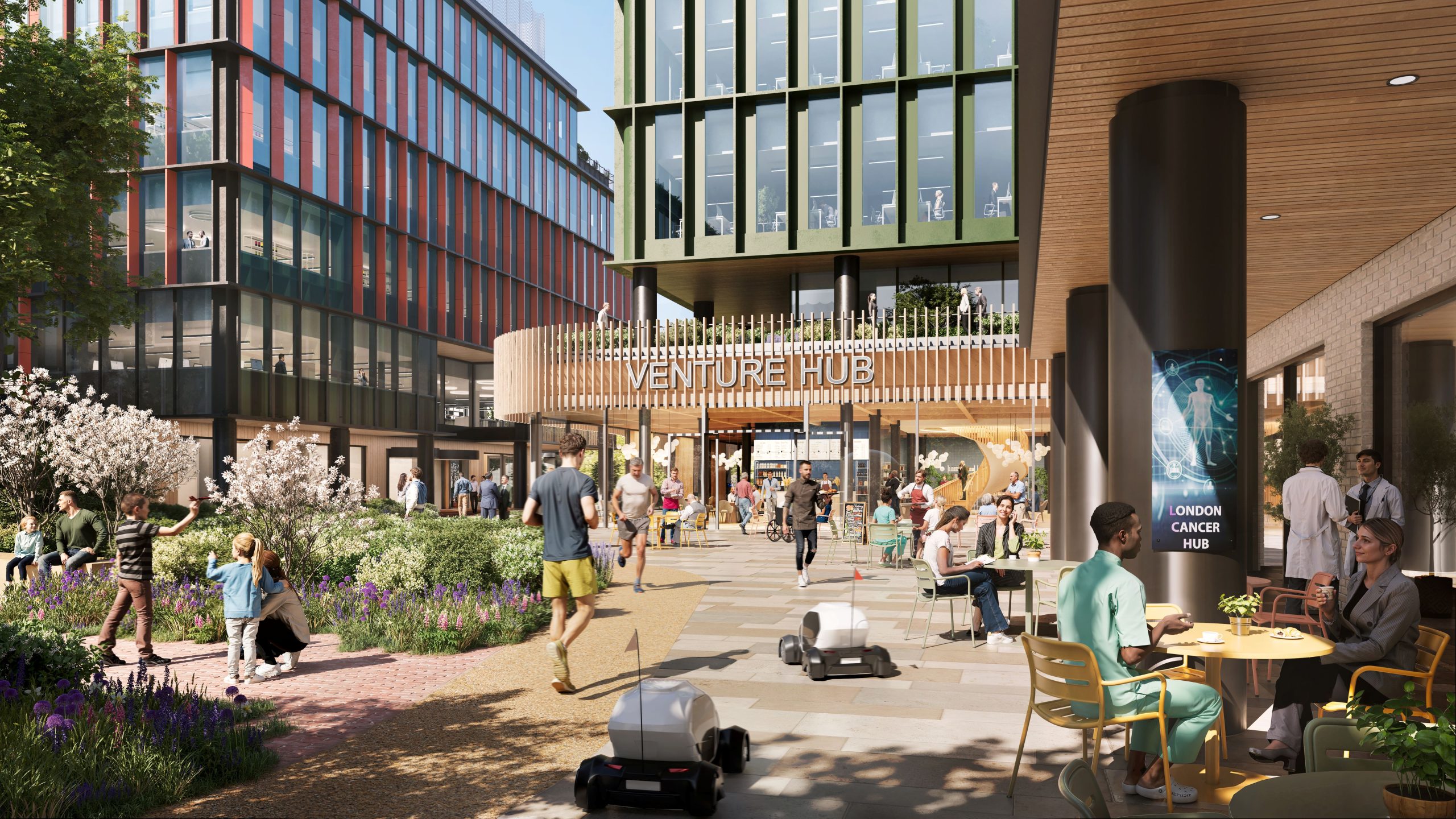
The London Cancer Hub will bring together research, clinical care, commercial life sciences, education and community infrastructure in one connected place. It will offer high-quality laboratory and research space, incubators for early-stage companies, and flexible environments that support collaboration and innovation, alongside everyday amenities that ensure the district works for the people who use it.
In doing so, it reinforces South London’s role as a location for knowledge-led, high-value employment.
Ecosystem building in action
One of the defining features of the London Cancer Hub journey has been the decision to invest in ecosystem-building alongside the planning process, rather than waiting for construction to begin.
Through the Innovation Gateway, early-stage companies are already operating on site, forming partnerships, collaborating with researchers and helping to shape the culture of the future district. These businesses are part of a growing innovation ecosystem that spans borough boundaries and sectors.
Events such as the Conquering Cancer Innovators Forum, held during London Life Sciences Week, have further demonstrated Sutton’s emerging role as a convening point for London and beyond. Bringing together entrepreneurs, clinicians, investors and patient advocates, the forum showed how place-based initiatives can connect local expertise to global conversations.
What this milestone enables for South London
With the planning framework now in place, the focus moves decisively to delivery.
For South London, this brings greater confidence: for businesses considering locating in the sub-region, for education providers developing skills pathways, and for investors seeking long-term opportunities.
The London Cancer Hub will support thousands of skilled jobs over time, strengthen links between education and employment, and help position Sutton and South London as places where innovation is not only created, but translated into real-world impact.
Looking ahead: delivery through partnership
As the London Cancer Hub moves from planning to delivery, partnership remains central. Ongoing collaboration with the Council, healthcare institutions, education providers, businesses and the community will be essential to ensuring the district grows in a way that reflects both local priorities and regional ambition.
Our focus now is on stewardship — supporting the district’s development as part of a wider South London story, and ensuring that growth is inclusive, resilient and purposeful.
What comes next will define not just a development, but a district that strengthens South London’s role in the UK’s life sciences future, while remaining firmly rooted in the community that made it possible.